22nd SESSION OF UCLG AFRICA’s EXECUTIVE COMMITTEE IN DURBAN

UCLG Africa will hold the 22nd session of its Executive Committee on November 09, 2019  (9:00) at the Onomo Hotel in Durban, South Africa. The meeting will be held as a prelude to the UCLG World Congress that will take place from November 11-15, 2019 in the city of Durban. The session will adopt the 2020 budget of UCLG Africa and discuss African participation in the UCLG World Congress.

We recall that Africa is contesting for the position of UCLG president for the 2019-2022 term. The candidate who represent Africa for this position is Dr. Mohamed Boudra, Mayor of Al Hoceima, Morocco, President of the Moroccan Association of Local Governments (AMPCC) and Vice president of UCLG Africa for North Africa Region.

The following leaders of UCLG Africa be participating in this meeting:

Mr. Léandre Nzué, Mayor of Libreville (Gabon), President of UCLG Africa.

Rev. Mpho Moruakgomo, President of BALA (Botswana), Vice-President of UCLG Africa for the Southern Africa Region;

Mr. Mohammed Boudra, President of AMPCC (Morocco), Vice-President of UCLG Africa for the North Africa Region;

Mrs. Soham El Wardini, Mayor of Dakar (Senegal), Vice-President of UCLG Africa for the West Africa Region;

Mr. Uwimana Innocent, President of RALGA (Rwanda), Vice-President of UCLG Africa for the East Africa Region;

Mrs. Dao Macoura, Mayor of Foumbolo (Côte d’Ivoire), President of REFELA (Network of Locally Elected Women of Africa);

Ms. Thembisile Nkadimeng, President of SALGA (South Africa);

Mr. Jean Pierre Elong Mbassi, Secretary General of UCLG Africa.

Following the morning meeting of the Executive Committee, UCLG Africa’s Pan-African Council meeting will be held at the same venue from 3pm. Participants in the Pan-African Council meeting will focus on the activities of the UCLG Congress and the organization of the Africities 2021 Summit in Kisumu, Kenya.

As a reminder, UCLG Africa’s Executive Committee is the body in charge of the political leadership of the organization. The Executive Committee is comprised of 16 members, 15 members equally representing each of the 5 regions of the continent, (3 for each of the 5 regions), plus the President of the Network of Locally Elected Women of Africa (REFELA). UCLG Africa’s Pan-African Council is made up of forty-five (45) active members, nine (9) for each African sub-region.

For more information, please contact:

Gaëlle Yomi:  Phone: + 212 610 56 71 45

Email:  gyomi@uclga.org

Visit our website : www.uclga.org

Join the session of young African local and regional elected representatives at the World Summit of Local and Regional Leaders

Are you elected locally in a municipality, province, region or county? Are you 35 years old or younger? Know that you represent the future of local Africa.

Joint the UCLG World Congress of Local and Regional Leaders from 11 to 15 November 2019 in Durban, South Africa, where a meeting of young African local and regional elected representatives is scheduled for 11 November 2019 from 16h30 to 18h00. This meeting will allow the establishment of the African network of young elected officials.

Please send your CV with a photo and a cover letter to the UCLG Africa General Secretariat to the following e-mail address Lnzamba@uclga.org ; Secretariat@uclga.org

For more information on the World Summit of Local and Regional Leaders, visit the website: www.durban2019.uclg.org


UCLG Africa President, Mr. Léandre Nzué visits the organization’s headquarters in Rabat

On Wednesday 23 October, 2019, Mr. Léandre Nzué, Mayor of Libreville (Gabon) and President of UCLG Africa, made a working visit to the organization’s headquarters in Rabat (Morocco). President Nzué’s delegation was composed of Mr. Eric Joel Bekalé, diplomatic adviser to the Mayor of Libreville and Mr. Jean Bruno Mipinda, Adviser to the Mayor of Libreville. This was an opportunity for Mr. Nzué to exchange with the staff of the secretariat and lead a working session, to which he was welcomed by the Secretary General, Mr. Jean Pierre Elong Mbassi.

After a brief introduction made by Mr. Mbassi, the heads of departments presented the main ongoing projects and requested the support of the President for their success. President Léandre Nzue reassured all of his commitment to lead the advocacy on behalf of African local authorities at the national and international levels.  He was, then, invited by the African Local Governments Academy (ALGA) to support advocacy for the consideration of human capital capacity building at the local level.

The Membership and External Relations Department presented the program on transparency and integrity at the local level and requested the President’s input to involve major African capitals in joining UCLG Africa and ministries as associate members. For the program management, the current major project is the establishment of the Africa Territorial Agency, which is a financial vehicle that will enable local authorities to have access to the financial market. The launch meeting of the AAT founding club is scheduled for 11 November, 2019 in Durban (South Africa), as part of the World Summit of Local and Regional Leaders to be held from 11-15 November, 2019. The city of Libreville intends to be part of the member cities of the founding club.

The Climate Task Force received an assurance from Mr. Nzué to take the concept of locally determined conditions (CDLs), initiated by African local authorities, into the negotiations for the implementation of the Paris Agreement. In the direction of COP 25, a hearing with the Gabonese Head of State will be requested so that he can defend this concept to the States, Gabon being the next country to chair the African group in terms of negotiations.

The Network of Locally Elected Women in Africa (REFELA requested the support of the Mayor of Libreville to raise awareness among national associations of local authorities to set up national chapters of REFELA.  To date, 24 countries have REFELA national chapters.

The migration program and the African Capitals of Culture program were supported by the President. Libreville City Hall has been invited to sign the Charter of local and subnational governments of Africa on Migration.

President Nzué also gave assurances concerning the headquarters of UCLG Africa’s Central Africa regional office, which will be located in the city of Libreville.

Lauching of the Refela Gambian Chapter

On 5 and 6 October 2019, the group of Gambian women mayors and local elected representatives chaired by Mrs Rohey Lowe, Mayor of Banjul Municipality, in partnership with UCLG Africa and UNDP, launched the Gambian National Chapter of REFELA (the network of Locally Elected Women in Africa).

The Mayor of Banjul, Rohey Lowe presided over the official launching at the Atlantic Hotel of Banjul. This launch was technically supported by the REFELA secretariat and the Network’s presidency, with the REFELA focal point, the Mayor of Banjul.

Mayor Lowe said the launch will mark a turning point in the aspiration of Gambian women in all areas of development. She explained that REFELA is the standing committee on gender equality of UCLG Africa. In accordance with REFELA’s Rules of Procedure, the new Gambian national chapter will be the Gender Commission of the National Association of Gambian Local Authorities.

She further disclosed that the campaign to better the lives of women as advocated by REFELA took a very positive turn through her election as the first woman Mayor of the Capital City of Banjul.

But the situation is more challenging for rural women whose active participation in governance especially in Local Government has been largely absent. And if the current situation remains unchecked the status of women with respect to active participation in electoral process and governance will only get worse,” she warned.

According to Mayor Lowe, women constitute far more than half of the population and they also constitute about 54% of all registered voters, yet they lack representation despite forming the majority.

Even though women are known to be loyal supporters and form the base of their political parties, they are still grossly under-represented in the hierarchy of their own parties and in other elective offices in the country“.

As mentioned in the Roadmap, all of the Sustainable Development Goals have targets directly related to the responsibilities of local and regional governments,” she disclosed.

Mayor Lowe called on women to be committed to the goals set by 2030 for Gambian women to reach remarkable heights in the political and economic development of the country.

The Gambian chapter of REFELA is already engage in the mains REFELA Campaigns :

Ø The Campaign for African Cities without Street Children ( Watch video of REFELA Gambia)

Ø The Campaign for African Cities’ Zero Tolerance to Violence Against Women and Girls (Watch video of REFELA Gambia )

Ø The Campaign for African Cities for Women’s Economic Empowerment

The launching of the Gambian chapter of REFELA, follow the dynamique impulse by REFELA after the last Africities8 Summit, held in November 2018 in Marrakech (Morocco).  On June 2019, another national chapter of REFELA was launch in Namibia, followed by the launch of REFELA chapter of Eswatini (Ex Swaziland).

Watch the resume of the lauching  ceremony fo REFELA Namibia.

UCLG Africa invites local and regional authorities to support OOAM’s advocacy for the ratification of the AU Protocol on the Free Movement of Persons

UCLG Africa joins the advocacy launched by the West African Migration Observatory for the ratification of the African Union Protocol on the Free Movement of Persons by AU Member States.  Freedom of movement is a right within the meaning of the Universal Declaration of Human Rights, and this right is essential for the development of our  territories at local level.

UCLG Africa invites the continent’s local authorities, through their national associations, to take this fight to national governments. Local governments have a key role to play in bringing this protocol to fruition.

Below is the content of the advocacy, highlighting 5 major arguments for successful mobilization.

The Protocol to the Treaty establishing the African Economic Community, concerning the free movement of persons, the right of residence and the right of establishment, was adopted at the 30th ordinary session of the Assembly of Heads of State of the African Union in Addis Ababa, Ethiopia, on January 29, 2018. Twenty-one (21) countries signed it on March 21, 2018, at the extraordinary summit of the African Union in Kigali (Rwanda). To enter into force, the protocol must be ratified by 15 member states of the African Union. This document is a line of argument elaborated by the West African Observatory on Migrations to convince the States about the benefits for Africa on the ratification of the protocol.

  • Argument of African Integration

The free movement of people on the African continent was one of the ambitions of the fathers of African independence who wanted to return to the freedom of movement that our ancestors had before colonization. Since the creation of the Organization of African Unity in 1963, subsequently with the establishment of the African Economic Community in 1991 and the African Union in 2002, African leaders have always emphasized the need to facilitate the mobility of Africans on their soil. The protocol on the free movement of people makes this dream come true. The ratification of the protocol on the free movement of persons by States is therefore an important step for the African Integration.

  • Humanist Argument

All men are born free and equal. But not all men are equal in the face of mobility. Depending on his nationality, an African citizen may be refused a visa or the right to travel to another African country. In addition, the administrative and financial requirements for visa applications create many obstacles that lead Africans to pay for expensive tickets at the last minute because the visa is issued late. According to the African Development Bank[1] , it is easier for an American tourist to travel in Africa than to an African businessman. The entry into force of the protocol will abolish once and for all the visa requirement for Africans who will thus be able to visit Africa more easily in order to discover its cultural wealth and to carry out fraternal exchanges between the populations.

  • Economic Argument

The launch of the Continental Free Trade Area (CFTA) in Africa is a historic opportunity to facilitate trade, tourism and industrialization on the continent. The UN Economic Commission for Africa (ECA) estimates that the implementation of the CFTA could increase intra Africa trade by 52% by 2022[2]. However, the benefits of this free trade zone cannot be achieved if Africans cannot move freely on their continent to make known and sell their products. The creation of a single market for air transport in Africa is also an important step forward that is changing the future of the African continent. The abolition of the visa requirement for African citizens traveling on the continent will allow everyone to be able to pay his plane ticket safely to make his trip. This will lead to increased transport and trade between African countries. In view of the economic benefits, African states have an interest in ratifying the protocol on free movement in Africa.

  • Sovereignty and Security Argument

The African Union’s protocol on the free movement of people does not put an end to the borders of States or their sovereignty on their soil. African States will have, according to the texts of the protocol, the right to control and register the people who enter and leave their territory. The contribution of the protocol lies mainly in the facilitation it gives to the mobility of Africans on the continent by allowing them to travel without a visa. States may also, if the situation so requires, raise reasons of security, health or protection of their environment to restrict the entry into their territory of persons considered to be detrimental to the stability of their country. Ratification of the protocol should not pose a problem since it takes into account the security concerns of States. It is also important to know that the protocol allows states to put in place, in successive phases, the related commitments, starting with the free movement of persons before reaching the rights of residence and establishment.

  • Scientific Argument

Academic exchanges, recognition of diplomas and the qualifications of the workforce are taken into account by the protocol. Thus thanks to the free movement of people, there will be more mobility for studies, exchanges between researchers, offers of seasonal or temporary services of competent people in various spaces in Africa. The protocol is therefore beneficial for a better sharing of knowledge among Africans, to increase technological innovation as well as the number of interuniversity scientific research in Africa.

[1] Africa Visa Openness Report : https://www.visaopenness.org/

[2] https://www.uneca.org/publications/african-continental-free-trade-area-questions-answers

Visit the West African Migration Observatory  website.

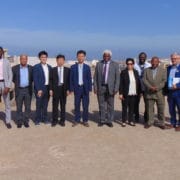
Signing of an MoU between UCLG Africa and the Seoul Human Resource Development Center (SHRDC).

UCLG Africa and the Seoul Human Resources Development Center (SHRDC, South Korea) signed a Memorandum of Understanding (MoU), On 5 October 2019 in Rabat (Morocco). The signing ceremony was held at UCLG Africa headquarters.

The MoU was signed by Mr. Jean Pierre Elong Mbassi, Secretary General of UCLG Africa and Mr. Yong Mok Shin, President of Seoul Human Resource Development Center (SHRDC) in Seoul Metropolitan Government (SMG),

This MoU formalizes the basis upon which both parties will cooperate on Human Resources Development and International Training Programmes related to sustainable urban development and targeting the human resources in African Local and Regional Governments, with the goal of building capacity for urban development, improving effectiveness in urban governance and enhancing the benefits of the Training Programme of SHRDC and the Africa Local Government Academy (AGLA) of UCLG Africa.

Mr. Yong Mok Shin expressed his willing to rely from now on UCKG-Africa to build a strong partnership between the two Institutions, through training programs focusing on HR development and urban development. The SHRDC has indeed development a strong program based on the Metropole of Seoul’s policies and best practices.

Mr. Jean Pierre Elong Mbassi expect the MoU would materialize a fruitful collaboration between the two institutions through joint activities, the sharing of expertise and visits, because “only human contact can build solid partnerships”.

The SHRDC President was accompanied by Mr. LEE Jong Hyuk, Head of the International Training Team and Mr. KIM Nam Chul, Programme Manager.

The ceremony was also attended on behalf of UCLG Africa by:

Dr. Najat ZARROUK, Director of ALGA, Mr. Charles PATSIKA, Director of the Membership and Public Relations Department, Mr. Mohamed NBOU, Special Advisor to the UCLG Africa Climate Task Force, Mr. Brygo GAUTIER, Director of the Territorial Coaching Programme.


Read the report of the ceremony.


Press Release -UCLG Africa welcomes the release of Khalifa Ababacar Sall

The African community of local and regional governments regrouped within the United Cities and Local Governments of Africa (UCLG Africa) welcomes the release of Khalifa Ababacar Sall, former Mayor of the City of Dakar after 2.5 years in detention.

UCLG Africa is delighted to be able to count on the talents of one of its best leaders who, as President of UCLG Africa from 2012 to 2016, has made our organisation’s voice heard with dignity in Africa and in the world.

During these two and a half years of absence, Khalifa Ababacar Sall’s determined, combative, but also constructive and visionary character will have failed his peers in Africa and other regions of the world, especially the members of the world organization of the United Cities and Local Governments (UCLG).

UCLG Africa fervently hopes to count once again on the commitment and leadership of Khalifa Ababacar Sall in order to carry ever higher the flag of a local Africa determined to contribute to the continuous improvement of the living conditions of the populations, committed to the achievement of sustainable human development and the unity of the continent, and determined to defend democracy, decentralization, and respect for freedom and human rights for all.

The Secretary General
Jean Pierre Elong Mbassi

Download the press release here

“Capacity building in the work place is very important”, Pam Belcher- Taylor, Mayor of Paynesville (Liberia)

Pam Belcher-Taylor is the mayor of Paynesville, the largest city in Liberia and home to approximately 320,000 people. Since her arrival in 2018 she has placed the capacity building of human resources as one of the main pillars of her mandate, especially for women and girls in the work place.  This has seen the creation of women’s groups to help young women who live on the streets to change their life conditions and gain work skills.

In this video Mayor Pam Belcher-Taylor talks about some of the projects initiated by her municipality and gives advice to youth who want to engage in politics.

Mayor Pam Belcher-Taylor shared Paynesville’s experience with other African local authorities during the  3rd edition of the Forum of Territorial Managers and Training Institutes targeting the Local Level in Africa (FAMI), which was organized by the African Local Government Academy (ALGA) of UCLG Africa, 10 -14 June, 2019 in Ifrane (Morocco).

Watch the interview below. 

View the presentation of Paynesville Projects  Here


Training of 23 local actors, municipal elected official and administrative officer of the municipal technical and financial partners on «Local Governance»

Within the framework of the Strategic Partnership between UCLG Africa and the National Capacity Building Programme for Cities Management (PNFMV) on the one hand, and the implementation of the College of Local Governance of the African Local Governments Academy (ALGA), the city of Yaounde hosted, from 16 to 20 September 2019, the first Training Session on the theme of: “Local Governance”.

This Training Session aims to raise awareness and strengthen the capacities of local actors on the issues and challenges of Local Governance, in a context of challenges and opportunities for African Local Governments.

The opening ceremony of this Session was marked by three speeches, namely, the welcome of the Vice-President of the United Councils and Cities of Cameroon (CVUC), the intervention of the representative of UCLG Africa – ALGA and the opening speech of the personal representative of the Minister of Housing and Urban Development (MINHDU).

In his welcome address, Mr. Albert Anicet AKOA, Vice-President of CVUC, praised the partnership between UCLG Africa – ALGA and the PNFMV in these terms: “I would like to magnify the excellence of the partnership between UCLG-Africa through its Academy and the PNFMV, for the development of the capacities and the skills of the Human Resources of African Local Governments, one of the weak links of the processes of decentralization in Africa. One of the result of which is the holding of this training session on the Local Governance, following the 1st International Training Session on Decentralized Cooperation organized in July 2019 “.

The Vice-President did not fail to make the link between the theme and SDG 11 to show the importance of this training in the eyes of local elected officials of Cameroon.

In his speech, Mr. Joachim HUNLEDE, representing the Director of ALGA of UCLG Africa, reminded the noble mission entrusted to ALGA by the local elected officials of the Continent, namely “to support and accompany the Members and the UCLG-Africa networks in their quest for visibility, autonomy, good governance, professionalism and performance “, which cannot succeed or be fruitful without the involvement and commitment of all stakeholders concerned by this dynamic, namely the State Representatives, Local Governments and their Associations, Training Institutes and Anchoring Institutes of ALGA, the Community of Experts and Trainers as well as the Financial and Technical Partners.

Read more