

The Truth About Migration
 “Can Development Co-operation Provide Solutions” Between the 4th and 5th of February the European Commission hosted the 6th edition of the forum “Cities and Regions for Development Co-operation.” Cities and Regions from across the globe are at the heart of sustainable development and there are many lessons and practices that can be shared with peers to address some of the critical issues ranging from poverty and food security to gender equality and climate change. What is Development Co-operation? Often described as development assistance offered by one region to another, usually a developed one to a developing one, and is a broad description for international action between two cities or regions that can be about
-Financial Support – traditionally what we recognise as “Aid”
-Capacity Support– human or organisational capacity building, technical support and sharing policy experience.
-Policy Change – of which decentralisation is a major component.
 The Forum addressed sustainable urban development through twinning, pairing and matchmaking of Local and Regional Authorities from EU and Partner countries which included Cities and Regions from Africa. The 2-Day event not only initiated discussion and debate on cooperation and development it also highlighted successful partnership initiatives including the Platforma Awards which aims to reward the best town-to-town and region-to-region development projects, promoting decentralised cooperation. The towns of Roeselare (Belgium) and Dogbo (Benin) received the first prize for their joint birth registration programme and after six years, Dogbo has become a reference in the field of civil registration in Benin, a country where more than 40% of births are not registered.
The Mayor of Dogbo, Vincent Codjo Akakpo spoke of the benefits of development co-operation and Cities and Regions across Africa are encouraged to explore the possibilities of such partnerships to drive sustainable development.
Jean-Pierre Elong Mbassi Secretary General of the United Cities and Local Governments of Africa lead a delegation from Africa to participate in a number of discussions on topics of interest including that of Migration.
As one of the hot topics between the EU and Africa UCLG Africa hosted a side event “Co-operate Around Migration” to provide a platform to interact and generate insights and recommendations directed to the European institutions on this important issue. Migration today is discussed as if it were a new phenomenon but this has been going on since the dawn of time from the “incredible human journey” when humans first ventured out of Africa some 60,000 years ago, and here we are talking about it in 2019 as if it were something new.


 The general theme for the Summit is “The transition to sustainable cities and territories, the role of African local and regional authorities”. This theme reconciles the need to provide concrete responses to the demands of the populations for the improvement of their conditions and living environment, with the need to adapt to an environment marked by climate change and the growing divorce between expansive growth models and the impossibility of continuing to borrow from natural resources at the rate that such models do impose, under threat of jeopardizing the lives of future generations. Africa will become the world’s largest home to humans in just less than two generations. The continent can and must take the path of sustainable development now, especially in its cities and territories, because it is the region of the world that is the least entrenched in the globalized economy, and therefore most likely to branch off to a more sober economy in terms of borrowing and discharges into the natural environment, an economy that is fairer and more socially inclusive.
 Cities and territories of Africa represent a significant share of the continent’s GHG emissions (about 70 percent in Sub-Saharan Africa) and they host millions of people in areas that are sometimes very vulnerable to the effects of climate change. They also concentrate the bulk of economic activity in Africa and the bulk of investment (infrastructure, business buildings, equipment, etc.). These realities reinforce the importance of the cities and territories of Africa in the implementation of the policies of fight against climate change.
 The flagship pan-African event of the United Cities and Local Governments of Africa (UCLGA Africa) will celebrate its 20th anniversary. It will bring together the 5,000 expected participants for creating a shared vision of the «Africa We Want».
  The future of Africa and its evolution are increasingly played out at the level of the Continent’s cities and territories. Globalization and rapid urbanization are the two powerful trends that mark this evolution. These two trends have a significant impact on the development of African societies. They raise questions about the effectiveness of the current growth and development models pursued in the African context, and even prompt one to consider a paradigm shift in the way people think about the Continent’s sustainable development.
 From the 8th to 10th of October 2018, Gaborone, Botswana played host to the Africa Regional Meeting of the Policy Forum on Development (PFD). The Policy Forum on Development (PFD) is a multi-stakeholder platform that brings together Civil Society Organisations (CSOs), Organized Private Sector and Local Authorities (LA) from around Africa to dialogue on critical development issues. The PFD recognises the European Commission’s 2012 communication on the “The roots of democracy and sustainable development” which clarifies the definition of CSOs in all their diversity and specificities. The PFD is supported by the European Commission and provides a platform where identified stakeholders’ together with EU Members States meet to debate on development matters. The regional PFD is organized on a rotational basis in addition to an annual global meeting.

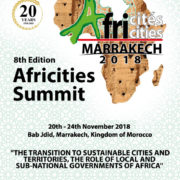
 In order to facilitate your participation at the next Africities 8 Summit, which will be held under the High Patronage of His Majesty King Mohammed VI, from 20 to 24 November 2018 in Marrakech, UCLG Africa provides you with an email address for all your questions around the summit.
 UCLG Africa, his African Local Government Academy (ALGA) and his Observatory of Human Resources of Local Governments in Africa, initiate the survey on local public services and the quality of service delivery in Africa Cities. The objective of this survey is to assess quality in the delivery of services of Cities in Africa through the perception of citizens and users over the period from January to August 2018. The result will be incorporate in the 1st Report on the state of HRM at the level of African Local and Regional Governments, which will be presented at the Africities 8 Summit in Marrakech from 20 to 24 November 2018.