

GCA and United Cities and Local Governments of Africa sign Memorandum of Understanding to scale up locally-led adaptation in Africa
To turn ideas into adaptation action in one of the world’s most climate vulnerable regions: Africa, the Global Center on Adaptation (GCA) and the United Cities and Local Governments of Africa (UCLG Africa) signed a Memorandum of Understanding (MoU) against the backdrop of COP26 in Glasgow, Scotland.
The new agreement, signed on 9th November, will facilitate and strengthen collaboration between GCA and UCLG Africa, the leading umbrella organization for African local governments, to support the urgent scale-up of locally-led adaptation throughout a continent that has the fastest urbanization rate in the world. In Sub-Saharan Africa, about 40 percent of the population lives in urban areas, up from 22 percent in 1980.
The African continent is disproportionately threatened by heatwaves, flooding and drought, and low-lying coastal areas, where about half of African settlements with 1-5 million inhabitants are located, have specific climate risks due to sea level rise and increased flood frequency, as stated in GCA’s flagship report State and Trends in Adaptation 2021, focused on the African continent.
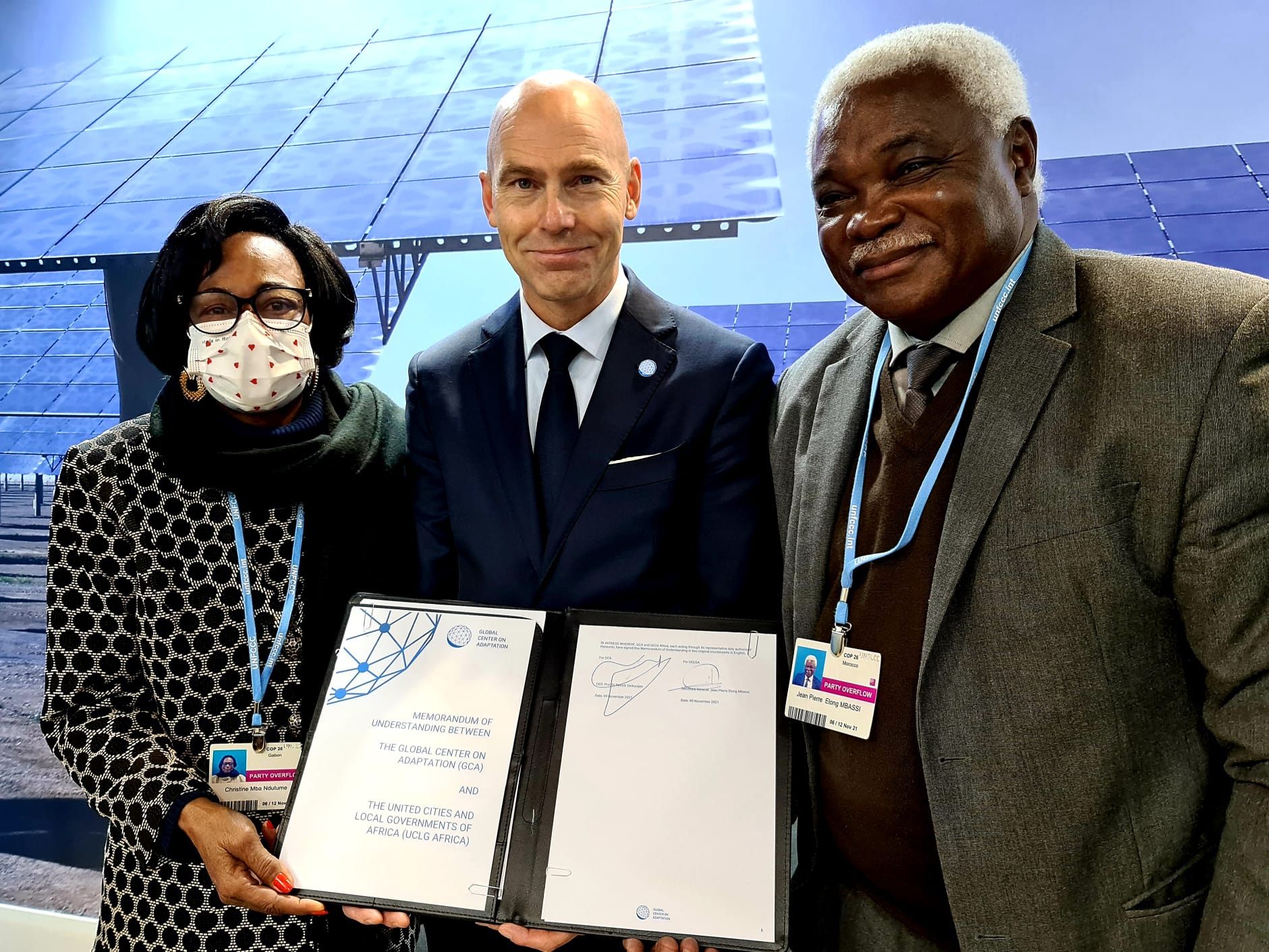
UCLG Africa President Christine Mba Ndutume Mihindou, GCA CEO Prof. Dr. Patrick Verkooijen, and UCLG Africa Secretary-General Jean Pierre Elong Mbassi
The Africa-led Africa Adaptation Acceleration Program (AAAP), developed jointly by GCA and the African Development Bank (AfDB), aims to mobilize $25 billion for adaptation in Africa in the next five years to address the impacts of COVID-19, climate change and the economy.
In line with the AAAP, the new agreement with UCLG Africa will promote the development and implementation of plans and programs to strengthen adaptation and resilience in African cities and territories, which provide unique opportunities for adaptation action because of their early stages of urbanization, particularly in Sub-Saharan Africa, and post-pandemic recovery.
“Working jointly with UCLG Africa, an organization that channels the united voice of local African governments, will enable GCA to deliver the AAAP on the ground in this region where adaptation can no longer be delayed, and immediate action is required,” said Prof. Dr. Patrick Verkooijen, CEO of GCA, who signed the MoU along with Secretary General of UCLG Africa Jean Pierre Elong Mbassi.
The MoU provides a framework for cooperation in three main areas: Programs and Action, Knowledge Acceleration and Advocacy and Agenda Setting.
GCA and UCLG Africa will jointly create platforms and opportunities for peer-to-peer learning for local governments and stakeholders, facilitate partnerships to bolster local government capacity and strengthen the gender approach in climate adaptation.
In terms of knowledge acceleration, the organizations aim to strengthen the framework for the acquisition and reporting of information and data related to resilience and adaptation by cities and local governments. They will also co-create knowledge products such as tool kits and knowledge-sharing platforms for local governments to assist them in identifying good adaptation practices.
Finally, the organizations will work jointly to advocate for early, strong and inclusive adaptation action by subnational and local governments, including through advocacy fora such as a Partnerships Market place for scaling up Locally-led Adaptation. They plan to explore options and barriers to accessing adaptation financing for urban and rural governments, where feasible, through GCA and UCLG Africa’s programs and initiatives and will promote African city leadership at regional and global fora, showcasing the challenges of climate adaptation across African countries and also the solutions ready to be scaled.
GCA will participate in UCLG Africa’s 9th Africities Summit, to be held from 17th to 21st May 2022 in Kisumu, Kenya. The events’ theme is “The Role of Intermediary Cities of Africa in the Implementation of Agenda 2030 of the United Nations and the African Union Agenda 2063.”
About the Global Center on Adaptation
The Global Center on Adaptation (GCA) is an international organization that works as a solutions broker to accelerate, innovate and scale adaptation action worldwide, in partnership with the public and private sector, to work together for a climate resilient future. Founded in 2018, the GCA is hosted by the Netherlands, working from its headquarters in Rotterdam with a knowledge and research hub based in Groningen. The GCA has a worldwide network of regional offices in Abidjan, Ivory Coast; Dhaka, Bangladesh and Beijing, China. Through this evolving network of offices and global and regional GCA teams, the organization engages in high-level policy activities, new research contributions, communications, and technical assistance to governments and the private sector.
For more information, visit www.gca.org.
About the United Cities and Local Governments of Africa
Founded in 2005 in Tshwane, South Africa, the United Cities and Local Governments of Africa (UCLG Africa), is an international pan African organization that aims to spearhead the decentralization of local governance in Africa.
Founded through a constitution adopted by mayors of African cities, its primary goal is to actualize the establishment of local governments with distinct legal and political personalities and financial autonomy. UCLG Africa is governed by a constitution which states that it is mandated to serve as the unified voice of local governments on the African continent. It was formed through the unification of three continental groups serving the interests of local governments and represents almost 350 million African citizens.
UCLG Africa acts to strengthen the capacity of local governments to provide better services to their population, to support and train Local Government Associations, and represent local authorities at the pan-African and international level.
For more information, visit www.uclga.org.
Contact
Alexandra Gee
Head of Communications, Global Center on Adaptation
alex.gee@gca.org


 Originally from Diarrère (Fatick region), Thérèse Faye Diouf holds a Master II in Sociology from Cheikh Anta Diop University (UCAD). She worked as an agent at the National Assembly. She has responsibilities since the early days with the Movement of Students and Republican Students (Meer) of which she was the national coordinator. In April 2012, Thérèse Faye Diouf was appointed to head the National Agency for Early Childhood and the Case des Tout- Petits (ANPECTP) to ensure a better policy for early childhood care. In November 2020, she was appointed General Administrator of the Guarantee Fund for Priority Investments (FONGIP).


 Jean-Pierre Elong Mbassi, UCLG Africa General Secretary said: «Recalling that decentralisation means the transfer of power relationship, responsibilities, capacities and resources from national to all sub-national levels of government with the aim of strengthening the ability of the latter to both foster people’s participation and deliver quality services as defined by the 2014 African Charter on the Values and Principles of Decentralisation, Local Governance and Local Development, UCLG Africa’s membership is happy to cooperate from now on with PSI as a strategic partner, to invest in human capital and quality public services at sub-national level, and make sure to leave no one and no place behind».
 Sani Baba, PSI Regional Secretary for Africa and the Arab Countries said: «Addressing the dire needs of the African and Arab Countries’ people for equitable access to quality local public services such as safe water and sanitation, heath care, energy, proper waste disposal, effective public transport, and decent housing is a major challenge for both our organisations. But working together we can unleash the unique potential of our local government constituencies to co-create and bring about concrete, progressive change to African cities and territories, to the benefit of local communities, as well as of local government institutions and their workers”.
 Rosa Pavanelli, PSI General Secretary said: «PSI and UCLG are stronger together when their respective memberships cooperate to confront the multiple, concurrent challenges they increasingly face, including pandemic, climate, unemployment and informality, migration, public service funding, gender equality and the respect of human rights. This first regional commitment brings the spirit of the global dialogue and cooperation built over the years between PSI and UCLG down to the ground of African cities and territories and I am confident it will translate into concrete actions at a local level”.


 Last May, the REFELA Côte d’Ivoire country chapter, of which she is also the president, organized the second edition of the gala evening called “The Mother’s Day”. It was an opportunity to celebrate the locally elected women of Côte d’Ivoire as mothers, but also as major actors in the development of Côte d’Ivoire, working effectively to improve the living conditions of their fellow citizens at the local level.


 Two panels structured these exchanges. The first, on the theme “Youth and responsibility“, addressed the political dimension of youth engagements at the height of the crisis, which was handled by Mrs. Thérèse Faye Diouf, Mayor of Diarrere; the impact of digital on the security dimension of our territories, was taken care of by M. Tom Marten.
 For his part, Mr. Marten emphasized the constraints of COVID-19 on international travelling particularly for tourism purposes. The tourism industry has been brought to its knees by the pandemic. The closure of frontiers worldwide indirectly accelerated the use of technology and innovation in the digital field. The use of digital technologies by governments, for example Seychelles has been favored to revive and foster tourism, in and to create the conditions for a return to normalcy and equally ensuring the health security of citizens and tourists. During this panel, the questions were mainly focused on the political aspects of the contribution of young people to the revival of urban economies: how to mobilize young people? How to increase the participation of young people in political parties? It was proposed that UCLG Africa and the national associations of African local governments, should develop advocacy for national governments and political parties, to facilitate the access to electoral lists and political affairs.
 The second panel addressed the issue of economic recovery by highlighting the role of young people in the field of entrepreneurship. In this panel, it was first a question of promoting the initiatives of young people who aim to create and find sources of funding, despite the context of the health crisis. Mr. Tchoungui thus encouraged young entrepreneurs and elected officials to make digital technology one of the keys to the development of African cities. To achieve this, improving and upgrading telecommunications infrastructure is essential, hence the appeal to the public authorities for more investment in this sector.
 Mr. Bastienne’s presentation showed how COVID-19 has impacted all areas of the private sector employing young people (drop in productivity, unemployment, etc.). The Seychelles Chamber of Commerce has supported young people by providing them with financing, technical support, and training, especially for entrepreneurs. The government, together with the private sector also designed a recovery and prosperity plan in which the youth participated actively. The importance of Information and Communication Technologies was underlined to show the impact of young people in digital development as a provider for the jobs of the future.
