High level consultation workshop

A UCLG Africa delegation led by Jean Pierre Elong Mbassi, Secretary General, UCLG Africa, participated in a meeting on 1-2 April 2015 at the AGI Headquarters in Dakar, Senegal. The UCLG Africa delegation included Mr. François Yatta, UCLG Africa Program Director; Mrs. Claire Mandouze and Mr. Daby Diagne, UCLG Africa special advisors.


The meeting was attended by delegates from Senegal (Prof. Ismaila Madior Fall, Legal Advisor to the President; H.E.M Omar Youm, Minister of Local Governance, Development and Spatial planning, Spokesperson of the Senegalese Government); from the Directorate of Political Affairs of the African Union, led by Dr. Mamadou Dia, Division Chief at DPA/AUC; from UNDP, from STC 8/ AMCOD sub committee; from Transparency International, from OFNAC (Prof. Jacques Mariel Nzouenkeu) and from the African Governance (AGI) led by its Executive Director, Mr. Maurice Enguenguele. In his introductory remarks, the Minister confirmed his resolve to support the setting up of the High Council because this project is in line with the direction that President Macky Sall is providing through the adoption of ACT 3 of decentralization.


The DPA/AUC presented progress report on the implementation of the High Council. A lot has been done, particular by the joined Senegal/AUC taskforce. The AU Commission report was adopted by the Executive Committee and endorsed by the Assembly in June 2014. The Assembly asked that a draft status, budget and financing model be prepared. A stakeholders consultative meeting is convened by the African Union in Dakar from 7 to 9 April 2015. The stakeholders consultative meeting objective is to prepare the communication to be presented to the Executive Committee and the Assembly for discussion and adoption.


Three key documents must be finalized and submitted to the formal process: the constitution, the budget and the structure. There is also a requirement that Senegal shall show commitment and send letter of interest with what it is putting on the table to host.

The legal advisor, AUC, highlighted that the Malabo conference has not yet adopted the High Council as the African Union organ as proposed by the Council; that a confirmation letter is sought on the political and budgetary commitments from the Government of Senegal, and that before the status of the High Council is adopted, it should be considered by the African ministers of Justice. The meeting of ministers of justice is convened by the legal department to November 2015. In the rules of procedures there is possibility  for extraordinary meeting.


In preparation to the stakeholders consultative a high level consultation workshop on the finalization of the projects of reference documents was organized in Dakar on 1 & 2 April 2015 at the invitation of the UCLG-A and the African Governance Institute (AGI). The high level consultation agreed to propose the following structure for the secretariat of the High Council:


– Executive secretary (P5)

– Senior political officer (P3)

– Local development officer (P3)

– Administrative & finance officer (P3)

– Bilingual administrative assistant (P2)

– Documentalist (born by host country)

– Driver (gs)

– Messenger (gs)


The high-level consultation also defined what the proposed host country (Senegal) as following:


– Furnished premises easily accessible

– Telecommunication facilities

– Accommodation for secretary

– Immunities and privileges applied to all staff

– Facility of entry visas


The budget of the High Council is supposed to be borne by the general budget of the African Union from 2018 onwards. In an interim period of 2016/2017, the annual budget required amounts at 550.000 dollars, among  which 400.000 dollars for the staff and 150.000 dollars for operating costs. The draft status of the High Council was reviewed for submission to the stakeholders consultative meeting scheduled on 7 to 9 April 2015.


The next steps:

1. The Senegalese party to confirm its commitments at the stakeholders consultative meeting and in writing no later than June 2015; 2. The stakeholders consultative meeting on 7 to 9 April 2015 in Dakar to adopt the preparatory documents for the Commission to respond to the questions raised by the Executive Committee and the Assembly; 3. The Commission to pursue the consultations with the AU institutions (CPR, Executive Commission, Assembly) between now and June 2015 with the aim to prepare the report to be submitted to the Assembly.

Related items

  • Pan African Peer Review 2: Call for Expression of Interest
  • FMDV releases a new publication on Subnational Pooled Financing Mechanisms
  • Commonwealth Local Government Conference
  • Establishment of National Associations of Local Governments: Assessment Study
  • Water at the Core of Local Governments Preoccupations

Tags :

AGI,  local governments,  developpement,

Water at the Core of Local Governments Preoccupations

The International Water Day celebrated every 22nd March of each year is seen as an opportunity to remind the public of the vitality of this rarefied resource. Aware of this reality, Local Governments reaffirm, via United Cities and Local Governments (UCLG), that access of the populations to water is one of their major priorities.

UCLG recalls that, back in 2004, the Final Declaration of the Founding Congress of UCLG stated that:

Access to water, in sufficient quantity and quality and at an affordable rate, should be a guaranteed human right for all, by using, if necessary, social measures or appropriate solidarity mechanisms for disadvantaged populations.”

However, over ten years later, the most vulnerable populations still do not have access to clean water and deaths related to health risks linked to a lack of safe water amount to millions of people each year. Facing this serious situation, Local and Regional Governments must mobilize in order to find suitable solutions.

In this perspective, UCLG co-organizes 4th International Conference of Local and Regional Authorities, to be held during the Forum, from 13 to 14 April 2015 in Gyongju, South Korea. This conference is in line with the upcoming World Water Forum, which is taking place on 12 to 17 April 2015. Local and Regional Governments will focus on the implementation of the Istanbul Water Consensus and on strategies and tools proposals.

An Implementation Strategy for Sustainable Water and Sanitation will be endorsed as a political declaration of the World Water Forum. The commitment of local and regional authorities will be indispensable in scaling up progress in sustainable water management.

You can get more details here.

Related items

  • Good practices on the management of water in Benin and Mali
  • Pan African Peer Review 2: Call for Expression of Interest
  • FMDV releases a new publication on Subnational Pooled Financing Mechanisms
  • Commonwealth Local Government Conference
  • Establishment of National Associations of Local Governments: Assessment Study

Tags :

Water,  International Water Day,  local governments,

Pre-EDD Event: The Presentation of the Transformation of Monrovia after Ebola

The UCLG Africa Secretary General, Mr. Jean Pierre Elong Mbassi, participated in the EDD in Brussels, Belgium, on 3 and 4 June 2015.

The EDD hosted nearly 5,000 participants around the theme “Our world, our dignity, our future”. The sessions organized in the framework of the EDD included:  human rights; citizenry; gender; inclusion; education; health; food; growth; jobs; trade; energy; climate; urbanization; financing.

The Secretary General moderated two sessions: on 3 June, on the topic: “Sustainable cities: good for the global North and not for the global South? » and on 4 June, on the topic: “Food security, resilience and structural change in West Africa”.

At a pre-EDD event organized on “the presentation of the transformation of Monrovia after Ebola”, by Honorable Mayor Clara Mvogo. The event was attended by the Ambassador of the Republic of Liberia and the Mayor of Dakar, Hon. Khalifa Sall, UCLG Africa President.

The Secretary General delivered the following opening remarks to the presentation.

Opening Remarks by Jean Pierre Elong Mbassi:

” Your Excellency, Honourable Nyenabo, Ambassador of the Republic of Liberia to Belgium and the European Union,

Clara Mvogo, Mayor of the City of Monrovia, Liberia

Khalifa Ababacar Sall, Mayor of Dakar, Senegal,

Dear Mr. Paul Dujardin, CEO of the Centre for Fine Arts in Brussels,

Our esteemed Moderator, Mr. Dharmendra Kanani, Director of Policy at the European Foundation Centre,

Honourable Invitees,

Ladies and Gentlemen,

Allow me first to extend a big thanks to Mr. Paul Dujardin, our gracious host in this marvellous Centre of Fine Arts of Brussels.

It is my privilege and honour as the Chair of the Cities Alliance Management Board, to welcome you at this Bozarevening reception. Tonight we have the pleasure to listen to a presentation of the transformation of Monrovia after Ebola, by Mayor Clara Mvogo.

Allow me to briefly introduce the Cities Alliance, which relocated to Brussels in September 2013. The Cities Alliance was launched by President Nelson Mandela in 1999 as a global partnership dedicated to the fight against poverty and to the promotion of the role of Cities in sustainable development. In 15 years, the Cities Alliance has supported slum upgrading programmes, city development and national policies all over the world.

The Cities Alliance members share the view that well-run cities offer an enormous opportunity to achieve sustainable development. We also believe that decisions should be taken at the lowest effective level – this is well illustrated by the Stop Ebola campaign that was so effectively championed by the City of Monrovia under the leadership of Mayor Mvogo.

In response to the Mayor’s request, the Cities Alliance has decided to define and implement a long-term programme of support through the Monrovia City Program. This will be a partnership that we wish other Partners join, and assist the mayor in turning Monrovia from despair to hope, particularly for the Youth.

We are pleased to announce that this Monrovia City Program is already backed by a series of donors and partners alongside the government of Liberia. Among the donors, it is worth mentioning Comic Relief, DFID, and USAID. Partners supporting the program are for now: Slum Dwellers International, UN Habitat, and Habitat for Humanity International and UNICEF.

And the Government of Liberia is supporting the city through the Ministry of Internal Affairs, the Land Commission, the National Housing Authority, the Monrovia City Corporation, and the Paynesville City Cooperation. Cities Alliance welcomes any other donor or partners to join this long-term engagement for the transformation of Monrovia as a sustainable City.

Thank you all for your participation and I hope you will enjoy this evening’s presentation.”

Related items

  • Monrovia mayor involved the community leaders to defeat Ebola
  • UCLG Africa on Radio France International (RFI)
  • Mission in Haikou, China

Tags :

EDD,  Ebola,  Liberia,

Habitat III PrepCom 2 Meetings in Nairobi, Kenya

The UCLG Africa Secretariat participated, on 12-13 April 2015, in the preparatory meetings towards the second assembly of local and regional governments in the framework of the PrepCom 2.

The meeting included:

1) A Local and Regional Governments’ constituency session on 12 April 2015 from 14:00 to 18:00; 2) A Policy dialogue with local and regional governments chaired by Mrs. Jacqueline Moustache Belle, co-President of UCLG on 13 April 2015 from 10:00 to 13:30; 3) The participation in the general assembly of partners of the World Urban Campaign on 13 April 2015 from 14:30 to 18:30; 4) The side event organized by the Cities Alliance on the role of partnerships in the implementation of the New Urban Agenda; and 5) The PrepCom 2 plenary and working sessions that ran from 14 April to 16 April 2015.

The issues at stake for local and regional authorities were the following:

  1. The extent to which the organization of the second world assembly of cities and local authorities (WACLA) will be part or not of the official program of the Habitat III Conference in Quito during the week of 17 October 2016; if it was, the mainstreaming of the preparation of WACLA in the roadmap of the official preparation process leading to the Habitat III Conference; if not the means to define in order that the voice of local and regional authorities becomes audible on its own right.
  2. Main ideas that the local and regional authorities want to bring to feed the new urban agenda.
  3. The partnerships to develop in order to translate the new urban agenda into concrete implementation on the ground.

1. On the organization of the second WACLA: 

So far this proposal has not yet received official agreement by the Habitat III secretariat. It appears however that it is getting buy-in from the executive director, UN Habitat, as well as from some members of the bureau of the Preparatory Committee for Habitat III. There is still need for strong advocacy and lobbying activities targeting in particular countries that are members of the working group on rules and procedures  for this working group to: a) accept to grant Local and Regional Governments a specific accreditation line (and consequently badges) distinct from the other stakeholders, b) include the WACLA within the official preparation and organization process of Habitat III, and c) grant local and regional authorities a slot at the plenary sessions of the Habitat III Conference. In the meantime, it is felt necessary to continue to collaborate with the assembly of partners but with the understanding that Local and Regional Governments are looking for their own and specific stream in the preparation and organization of WACLA in the framework of the Habitat III Conference.

2. On key Local and Regional Governments concerns to be included in the new urban agenda:

Participants insisted on the need to recognize the uniqueness of Local and Regional Governments as they are placed at the intersection of the vertical public governance system and the horizontal and territorial playground of local stakeholders or stakeholders with strong local impact. That is the reason why local authorities should be at the heart of any Habitat III implementation strategies.

Therefore localizing these strategies matters, so also do local actions that should be seen as the most efficient route to tackling global challenges, since cities will form, from now on,  the bulk of human population on earth. In other words, Local and Regional Governments support the adoption of the subsidiarity principle for, and of the territorial approach to an effective implementation of the Habitat III Agenda. This Agenda should be the convergence of the other global agendas such as the Climate agenda or the post 2015 SDG agenda.

Local and Regional Governments want to bring to the fore: the issue of good territorial governance and request that it be considered as a public good, the issue of resilience encompassing human and social resilience beyond environmental, physical, and disaster management resilience. In that sense, Local and Regional Governments wish that the new Urban Agenda reflects on human dignity and human rights in cities, which are embedded most of the time in respect to culture and cultural diversity.

They wish that city diplomacy related to both conflicts prevention and management of migrations also form part of the new urban agenda; local and regional governments are concerned about the discrepancy between new responsibilities falling on Local and Regional Governments as the consequence of the adoption of decentralization policies and their weak financial and human capacities to deliver on their mandates.

The financing for development agenda should therefore address the daunting issue of local finance. Given the current global mood adverse to taxation, it is important to explore where public resources will be coming from to ensure that public authorities, starting from the Local and Regional Governments, will have the means needed for the implementation of their share of the Habitat III agenda. A case should be also made about costing long-term urban investments needs based on current technological network solutions that are mostly centralized, whilst the observation shows rapid evolution towards more decentralized and localized technologies, leading to less intensive  investments and hopefully lesser financial needs; the tendency towards more circular economy and short financial processes is emerging as key on going innovations being adopted by numerous local and regional governments concerned with sustainable development policies and strategies. It is important that the New Urban Agenda focus needed attention to these emerging innovations and their impact on the management and governance of cities and territories.

3. On the Partnerships to develop:

Participants approved the proposal to build a strong compact with women and other civil society organizations around for instance, the promotion of safer cities and safer public spaces, especially for women. There was a shared agreement that the recourse to public/private partnerships has shown many limitations given the volatility of the financial markets, the reluctance of multinational companies to invest in medium size and small cities, and the difficulties encountered by most Local and Regional Governments to access this market. However, there are examples where win-win partnerships were witnessed between the private sector and local and regional authorities. This happens when the business sector is encouraged to invest on the territory where its activity is developed.

Such territorial investments should form part of its social responsibility and can be strongly instrumental to the improvement of the image and branding of its companies. But local and regional  authorities should also be aware of the rapid change happening at the workplace due to the impact of digitalization and automation. The spatial impact of such evolution should not be underestimated and there is need for foresight studies that can equip local and national authorities with needed knowledge to mitigate upfront any ill consequences of these evolutions.

There is an urgent need to develop collaborative, cooperative, and mutually supportive governance between the National and the Local Governments if the New Urban Agenda ought to be implemented. This is the most crucial partnership for the implementation of the Habitat III Agenda and everything possible shall be done to get this partnership up and running throughout the world.

Related items

  • Habitat III: Open-ended Informal Consultative Meetings
  • Habitat III Africa Regional Meeting in Abuja, Nigeria
  • Global Taskforce: “Post-2015 Agenda will fail without local governments”
  • International Guidelines on Urban and Territorial Planning: A key tool to support the New Urban Agenda
  • Meeting of UCLG presidency

Tags :

Prepcom II,  Urban Agenda,  Habitat III,

European Mayors Meeting on Climate change

On his way back from Johannesburg, the Secretary General, UCLG Africa, participated on 26 March 2015 in a meeting of European mayors on Climate change at the Paris City Hall at the invitation of Ms. Anne Hidalgo, Mayor of Paris.


The meeting was the opportunity for numerous European cities to exchange on cities initiatives on reduction of green gas emission, the adoption of renewable sources of energy and actions around smart solutions in transport in particular with the adoption and extension of electric cars, climate adaptation plans, urbanism through extension of pedestrian areas in cities, promotion of green and circular local economies.

The meeting discussed the role of public procurement to harness a more sustainable development path for the European cities aiming at meeting the commitment to reduce green gas emission got at least 5 % per annum. The meeting gathered over 30 major cities of Europe. The meeting was addressed by the President of the Republic of France, Mr. François Hollande. He stressed the importance of mayors and local authorities in the fight against Global Warming. He said that the Philippines witnessed around 350 cyclones. In Vanuatu 90% of the territory was destroyed by the recent cyclone. This why it is important to be aware of the reduced window of opportunity to act.

The COP21 is a turning point. France is working towards a mandatory agreement for the reduction of global warming. Europe can show the way through the objective defined by the Union on energy and its contribution for the reduction of global warming. The other countries has expected to produce their contribution, including USA and China. What is expected is the production of an agenda of solutions, in particular from cities and local governments. Cities are called after to become sustainable cities.

In the agenda of solutions there will be a census of best practices and cooperation around climate change investments. Cities should also be at the fore for mobilizing the different cities and the other stakeholders in order that what will be difficult negotiations will need the support of everybody in order that the world adopts a new transition model towards a more sustainable development path. This is the only way to get a world that is more just and sustainable.

Related items

  • The Compact of Mayors: Mayors Commitment on Climate
  • World Summit on Climate and Territories
  • UCLG Africa on Radio France International (RFI)
  • Territorial Coaching Forum in Nador, Morocco
  • UCLG Africa signs a Partnership Agreement with the European Commission

Tags :

climate change,  European cities,  Sustainable Development Goals,

Mrs. Joana Ntaja is no more

Mayor for Zomba City (Malawi), MALGA Association and REFELA member Mrs. Joana Ntaja is no more.
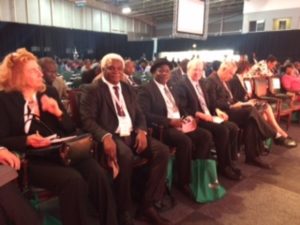
Ntaja, who hit headlines as a strong woman to take to the administration at Zomba City Council as a Mayor, died in the early hours of March 8, 2015 at Mwaiwathu Private Hospital in Blantyre. Ntaja was only 30 years old.


May her soul rest in peace.


Related items

  • REFELA President: Installation of REFELA-Senegal
  • Africities 2015: Election of Africa’s Network of Locally Elected Women (REFELA) New President
  • Implementation of the Locally Elected Women Network (REFELA) in Gabon
  • Meeting of the Network of Locally Elected Women of Africa (REFELA)
  • REFELA President appointed « Global Champion » at the World Disaster Risk Reduction Conference

Tags :

MALGA,  REFELA,

SALGA National Members Assembly

24-26 March 2015, Gallagher Estate and Convention Centre, Midrand, Gauteng
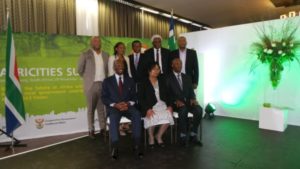
The proceedings started by Minister COGTA, Pravin Godham, introducîng President Jacobs ZUMA to the house as a leader who stresses  the importance of public good and public interest.

The president has set up a National Development Plan and the integrated development planning processes. He endeavored to build democratic structures that have had impact on the improvement of the living conditions of the people.

In his speech to SALGA members, President Zuma extended his warm welcome to special invitees, with an emphasis on the President and Secretary General of UCLG Africa. He confirmed his resolve to consolidate and deepen a vibrant, developmental and people centered local democracy.

South Africa has adopted a democratic constitution, which is a bold declaration aiming at curving the illness of the past apartheid legacy. Significant progress was made in line with the freedom charter in term of achieving the provision of services to communities, with an upward trend reported in more than 70% of South African local governments.

Progress has been witnessed in many areas such as water and sewage services provision, access to energy and to housing. But human costs of apartheid are still with us. We need therefore to identify challenges towards establishing a non-racist and prosperous South Africa. Many South Africans are still waiting for the improvement of their living conditions. Scarce resources did not allow to speed up the delivery system, but we are encouraged by the capacity of local governments to find local solutions. Those preferment municipalities are the ones that are well governed, where councilors observe monthly financial scrutiny, care about clean administration with fraud avoidance and zero tolerance to poor service delivery. Management systems should be improved, with annual audit reports, and skills acquisition for local administration staff. Key to problem solving in local government is the need not to get local staff to recourse too much to consultants. It is important to tighten the use of consultants.

Community should be part of the municipalities’ daily work in order to build trust between people and government. On September 2014 the Government committed to support full functioning municipalities that should service the communities and agreed to go back to the basics.

This means a recommitment to provide basic services in a professional way, put people first through working with communities, making harder efforts to expand poverty alleviation programs through support to local economic development, improving effective public administration which shall not be seen as a privilege in a democratic system but rather a fundamental right of citizen. This is the type of government we should all strive for at all levels of governance. Achieving a prosperous South Africa is a long journey for which cleaver citizen should take responsibilities. People should participate in the building of their own future. We need to anticipate in our development. We need to change the phraseology of service delivery. Rights goes with responsibilities.  We need good communication to empower people so that they can provide for themselves.


Local government authorities are godfathers for delivery. But most of the time local Authorities change their behavior once elected and become isolated from the people. This trend shall be  combatted among SALGA members.


After the President’s speech, the assembly received support messages by United Cities and Local Governments (UCLG), the Commonwealth Local Government Association (CLGF), the Botswana Local Government Association (BALA), and United Cities and Local Governments of Africa (UCLG Africa).

In his opening remarks, the Premier of Gauteng Province, Honorable D. Makhura, stressed that the Councilor’s job is a difficult one, because councilors are the ones who take the blame when anything goes wrong at local level, even if the problems stemmed from actions by other spheres of governance. He therefore pledged support to the councilors.


After the opening ceremony, the proceedings continued with a grand debate organized around 15 years of democratic local government in South Africa with as panelists: Mr. V. Moosa, first minister of democratic local Government; Father Smangaliso Mkathswa, former Chairperson of SALGA; Cllr Parks Tau, chairperson, SALGA Gauteng; Hon. L. Tsenoli, Deputy Speaker of the National Assembly; Ms. W. Ovens, Local Government Researcher; Dr. M. Ndletyana, MISTRA. The panel was moderated by T. Modise.


The assembly went on with a series of sessions on: Enhancing consequences and accountability in local governments and promoting leadership development in the sector; Launch of the SALGA Centre for leadership and governance; Celebrating and stimulating innovation and good practice in local Government and key issues affecting local Government for consideration in commissions.


Eight Breakaway commissions were later on organized in parallel on the following issues: 1. Enhancing good governance and accountability; 2.Urban development and spatial integration; 3. Sustainable local economies; 4. Future of the electricity distribution industry: 5. Boundary and ward demarcation; 6. Women empowerment and gender equity in local government; 7. Improving financial management, audit outcomes and fiscal policy; 8. Strengthening organized local government.


After the presentations of report back on commissions, the assembly discussed and adopted:  (1) the framework for good local governance; (2) the municipal audit support programme of SALGA; (3) funding model for sustainable long-term relevance and impact; (4) SALGA roadmap to 2016.

The assembly was closed with a vote of thanks by Cllr Thabo Manyoni, Chairperson, SALGA.


Africities Diplomatic Corps

A Delegation of the UCLG Africa led by the UCLG Africa Secretary General participated in a meeting of the Diplomatic Corps accredited in the Republic of South Africa on 23 March 2015 at the Johannesburg City Hall.

The meeting was open with a welcoming address by Cllr Rosemary Thobejane-Ndogo, Chairperson, governance oversight committee, on behalf the Speaker of the City of Johannesburg, Ms. Connie Bapela.


Then followed the remarks by COGTA presented by Ms. Gigi Gosnell, Head of International Relations, on behalf of Mr. Vusi Masonsela, Director General, and Cooperative Governance. She confirmed the commitment of the South African Government to work hand in hand with the City of Johannesburg and SALGA for the hosting of the Africities Summit, which is rated as a national event for the country.

The 7th edition of the Africities Summit takes place at a moment when South Africa is celebrating the 15th anniversary of the establishment of a Local Government system in South Africa. The white paper  adopted in 1999 defined local government as a sphere of government that contributes to the wellbeing of communities by providing them with basic services, and where social accountability can be enhanced. Despite the progress registered in the implementation of the local government system in South Africa, there remain numerous constraints to be addressed. Namely, how to cope with rapid urbanization that is being translated in most cities in the difficulty to address moving and changing targets in the governance of our cities, the issue of safety and security; the issue of unemployment and the spread of poverty; the issue of inequalities and exclusion in the cities.

In order to curve these trends, the Department of COGTA has launched a Back to the Basics Approach (BBA) in order to improve service provision, implement more coherent developmental outcomes at local level and build more effective, efficient and accountable local authorities at the service of the communities. The motto behind the BBA is Putting People First, to build trust between public authorities and citizen. Africities offers a unique Platform that can be used to address the priority issues facing Africa and to define the way forward in the building of a developmental state in Africa.

On behalf of Cllr Thabo Manyoni, Mayor of Magaung, Chairperson of SALGA, Mr. Xolile George, CEO of SALGA expressed the support of the organization to the City of Johannesburg, and the sense that this was a collective endeavor for the South African Local Governments. He highlighted the fact that SALGA is holding its National Members Assembly on 24 to 26 March 2015 in Gallagher State and Convention Centre in Midrand, Gauteng Province, the last of its kind before Africities and the local elections next year. This will be also a good opportunity to mobilize SALGA members’ participation and raise SALGA concerns to feed into the Africities Summit Program.

Mr. Jean Pierre Elong Mbassi, Secretary General, UCLG Africa, first extended to the audience apologies from Hon Khalifa Ababacar Sall, Mayor of Dakar and President of UCLG Africa, who would have loved to be present but had to attend to urgent duties in his city. He then presented the rationale behind the UCLG Africa and the Africities Summit, which is mainly to participate in the building of the unity of Africa and to shaping its development from the grassroots. The vision adopted by the members at the founding congress of the organization in May 2005 in the City of Tshwane was for UCLG Africa to contribute to the emergence of an “Africa of the Peoples” beyond the “Africa of the National States”. The Africities Summit is the flagship event of UCLG Africa celebrating the contribution of African local governments to the development, democracy, integration and unity of Africa. Six editions have been organized so far, in Abidjan, Cote d’Ivoire, in 1998; in Windhoek, Namibia, in 2000; in Yaoundé, Cameroon, in 2003; in Nairobi, Kenya, in 2006; in Marrakech, Morocco, in 2009; in Dakar, Senegal, in 2012. The organization of the 2015 Africities Summit is the result of a competitive bidding process won by the City of Johannesburg. The theme adopted by the Africities Political Commission for the upcoming Summit in Johannesburg, South Africa, on 29 November to 3 December 2015, is “Shaping the future of Africa with the People”. It is the true translation of the aspirations of our organization to inspire and link the initiatives of the top leadership of the continent with the realities of the living conditions of the African people at the grassroots level. The 2015 Summit comes after the recent adoption by the Heads of State and Government meeting in June 2014 in Malabo, Equatorial Guinea, of the African Charter on Values and Principles of Decentralization, Local Governance and Local Development; and of the decision at the same meeting to create a High Council of Local Governments within the African Union. The UCLG-A calls on the African Diplomatic Corps to help promote the ratification of the Charter by national governments of Africa, and to sensitize them on the process of designation of their representatives on the High Council. The Africities 2015 in Johannesburg builds on the Agenda 2063 of the African Union, with a view to populate its provisions and to have them owned and nurtured by the African Stakeholders. An International Exhibition of cities and local governments of Africa will be organized in parallel of the Summit’s proceedings, at the SandtonConvention Center, from 29 November to 2 December 2015.

The Exhibition will bring together more than 150 exhibitors from public and private sectors and will offer the business community an excellent platform to interact with over 6000 delegates at the Summit among which, key decision makers on the continent, Ministers, Local Authorities, Mayors, Presidents and Heads of Local Governments, Representatives of regional and international institutions…

The Africities Summit will also host important events such as the general assembly of UCLG Africa where new office bearers will be elected, same for the network of women local elected officials (REFELA, its French acronym); the meeting of ministers in charge of public service, local governments, urban development and decentralization. Also a political dialogue meeting between ministers, local authorities, African Union institutions, development partners; a meeting of Honorary members of UCLG Africa, former African Countries Heads of State that have supported the development of UCLG Africa and the Africities Summit, are programmed.

Meetings between Local Authorities from Africa with their counterparts from Brazil, China, Europe, and Turkey; meeting of African traditional authorities; meeting  of the African Diaspora and Afro-descendants, He concluded his remarks by thanking once again the Diplomatic corps for their attendance and said that he looks forward to welcoming their delegations to the Johannesburg Africities Summit in November.

In his remarks to the audience, Cllr Kgosientso Ramokgopa, Executive Mayor of the City of Tshwane, expressed the view that Gauteng is seen by the leadership of the province and its three major cities as a single City Region which, explains why the Gauteng leadership stood firm in support to the candidature of the City of Johannesburg to bid for the Africities Summit. He lamented that Africa was not so far able to provide an alternative narrative on urban development and the way to manage cities in Africa. He said it was just time for Africa to do so, since African cities dynamics cannot compare with any others in the World. African cities leaders and citizen cannot learn much from urbanization in the global North. He said that in this part of the World the urban growth happened on a slower pace than in Africa where the rate of urban growth is around 5% to 6 % per annum, which doubles the population and size of African cities every 12 to 20 years.

In the global North urbanization was the response to the growing demand for workers in cities where industrial manufactures were being developed very rapidly. No such thing is happening in African cities where the rush of people to cities exceeds to a very large extent the capacity of cities to provide decent work and means to earn a living to everyone. Consequently, African cities are the room for growing poverty and inacceptable living conditions for a majority of city dwellers. In the global North, the city has been a place where the realization of citizen aspirations and rights was made possible because the public authorities had the means to attend to the demands of most of citizen.

This is far from being the case in Africa where the resources managed by local authorities are critically insufficient to address even the basic needs of the population. In the global North, the economic transformation stemmed from the intensive use of natural resources endowed in the countries and their colonies, in particular through access to fossil sources of energy. The African economic transformation is suffering from nowadays-greater international attention to the impact of climate change, calling for a restrictive use of fossil sources of energy, thus putting a limitation to the capacity of Africa to tap into her endowment in energy resources for the structural transformation of the continent’s economy.

This is why the position of Africa in the climate change negotiations has always been to take better account of the concept of shared but differentiated responsibility, so to guarantee that this continent is fairly treated pertaining to her access to the means of its economic structural transformation. For over ten years, Africa has been witnessing an economic growth rate close to the one experienced by the Asian emerging economies. But this economic growth is not translating in real change in the urbanization pattern of Africa and in the appearance of more integrated and inclusive cities. To the contrary, the growth of African cities is often materialized in the growth of informal settlements, contrary to what is observed in cities of the global North. So, time has really come for African leadership to define original proposals for the future of African cities, the momentum for this being provided by the African Union Agenda 2063. Africities will therefore be a key milestone for these important foresight reflections.

The Dean of the Diplomatic Corps accredited in South Africa, Ambassador Bene M’Poko from the Democratic Republic of Congo (DRC) said he was here to pledge the support of the Diplomatic Corps to the Africities Summit. People’s quality of life depends largely on the way local authorities fulfill their mandate, in particular in the delivery of basic services and in making sure every citizen lives in a peaceful and secured neighborhood, with the possibility to decently earn a living, educate and grow his/her children and participate in the democratic, social and cultural life of the City. He cited Bogotá, the capital city of Colombia, as his ideal city, because there, the citizen needs are taken care of, there is room for everyone. This is the only way you can have a sustainable and inclusive city. If Africities can be a platform where to reflect on the way to define the ideal African City, it is more than welcome and timely. He expressed the wish that the Africities adopt a pragmatic approach leading to the translation of the Summit’s discussions and debates to implementable strategies and targets.  He confirmed that the 47 African diplomatic representations based in South Africa are committed to mobilize all cities of Africa to attend and wished that the Africities is successful.

In its closing remarks, Cllr Parks Tau, Mayor Johannesburg, stressed the importance of unity finding behind the African Union Vision 2063. Events like the Africities Summit are possible only because the cities of Africa are united within the UCLG-A. The 2015 Africities takes place on the eve of COP21 and the dates for hosting the Africities were readjusted to allow Africa to be present in COP21 in Paris. The Africities takes place also during the year of the adoption of the Post 2015 Sustainable Development Goals, when the continent is faced with the effects of rapid urbanization that is appealing for a new Urban agenda for the continent. Despite the growth of African economies, the living conditions of the African city dwellers are not changing much.

Africities will offer an opportunity to learn from our successes and failures to stimulate social cohesion in African cities. This social cohesion will come to be only if government is connected with the people. The theme of the Summit means exactly that, since it is about “Shaping the future of Africa with the people”. There is urgent need to collect to People’s views and inputs in the Africities proceedings in order to contribute to the design of the successive 10-year action plans for the implementation of the Agenda 2063 of the African Union.

Only through such endeavor will the Agenda 2063 become a true living forces mobilization instrument on this continent. This is reflected in the Summit’s Architecture that manages a dedicated space to have the views of the different stakeholders whose contribution is key in shaping the future of Africa.

The Mayor expressed his conviction that with the support of the South Africa national government, the Gauteng provincial government, the collaboration of the Cities of Tshwane and Ekhuruleni, the backing of SALGA, and the engagement of the Diplomatic Corps as well as other actors, including the development partners, the Africities Summit in Johannesburg will be a great success. The Mayor of Johannesburg further presented the architecture of the Summit.

The proceedings ended with press briefing held with the Dean of the Diplomatic Corps and the Mayor of the City of Johannesburg.


Call for African Experts: Submission date extended

Due to the important interest stirred by our call to tender for African Experts, UCLG Africa is pleased to announce that the submission deadline has been extended for another month.  The new deadline for submitting applications is now the 20 April 2015.
 

The goal of this Call on experts is to build a database of African experts in different disciplines and scientific fields for consultancy service when necessary and appropriate. This is of paramount importance given the vitality of information and intelligence in the process of development.

Therefore, UCLG Africa is kindly asking all its members and partners to spread the word around their networks in order to encourage the application process. The goal is to provide all African Local Authorities with the necessary knowledge and intelligence needed to develop and prosper.

The respondents to this call for registration are requested to provide the following information by completing the online registration form, noting, especially the following elements:

a) The full coordinates of the respondent;

b) Qualifications and key competence areas;

c) Experience and relevant research, studies, and other undertakings carried out indicating when. Kindly indicate which undertakings were conducted for African institutions;

d) Indicate your areas of interest/ specialty.

Applications must be sent before 20 April 2015.

To interested experts, please, send your CV attached to the following e-mail address: africanexperts@uclga.org


Policy Forum for Development Global Meeting

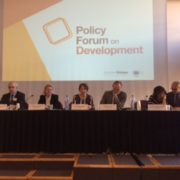
The Secretary General participated in the global meeting of the Policy Forum for Development in Brussels from 16 to 18 March 2015.

The meeting started with a preparatory meeting on 16 March in the morning at the Management Centre Europe (MCE). The preparatory meeting covered ways to increase support to PFD members through network consultation and research. The EU will work with task team members to select research topics and research experts and teams. The budget allocated for research is around 200,000 euros over 3 years period, which means 2/3 researches a year (at an average of 50,000/70,000 euros). It is expected that the topic for research will be explored.

The preparatory meeting further discussed the Finance for Development process. The process started with the UN conference on international finance discussions in Monterrey in 2002. This was followed by the Doha FfD conference in 2008 that took important steps on domestic resource mobilization and international tax cooperation. After the 2008 crisis, a UN conference was called to discuss the groundbreaking Stiglitz Commission report, which was adopted as a document for the General Assembly, but has been forgotten since. The report highlighted the transformational steps to be taken to tackle the systemic financial risks of the international financial order. Coming up is the Addis Ababa FfD conference from 13 to 16 July 2015.

The post 2015/SDG Finance also sets up expert recommendations on Financing Sustainable Development.

For the Addis Ababa FfD Jean Saldhana from Concord presented the 6 proposed priorities of the civil society Organizations 1. A new intergovernmental tax body; 2. Recognition of illegitimate debt; 3. Capital control and regulation of international financial flops; 4. Democratic scrutiny of Trade negotiations and capital controls; 5. More accurate information on ODA: targets, timetable, measurable real flows, additionnality; 6. Attention to systemic issues: financial reform, transparency and governance, membership reform of the Bretton Woods institutions; UN role in global economic issues with the creation of the UN Economic council, promotion of ownership and policy space for civil society in countries.

Edgardo Bilsky from UCLG explained that local authorities were not part of the debate from the beginning. The main doubt is about the need to increase the financial flows for Development and how these flows will reach the local level. Not leave anyone behind calls for a mechanism that allow grassroots people to access the funds, so that local communities are part. We need to include in the “element paper” to improve subnational inclusion in the FfD. The tax system should be decentralized to tap into the domestic resources. We call for a better sharing of resources and expenditure between the national and subnational levels of governance. Addressing the balance between different territories through territorial solidarity is also an issue, which is not reflected in the debate. The role of the Private sector in investment is very much volatile and concentrated in sectors with quick return, which is not always the case for basic services that respond to the needs of the local people and communities. The PPP should be serving more the communities. This is not been fully addressed in the debate.

Many conflicted issues are at stake for the Addis FfD conference: the 0.7 per cent commitment, the debt issue, the tax issue (tax evasion, tax avoidance, tax heavens, mobilization of national resources). The dominant debate links FfD to structural issues beyond finance, covering also on trade issues. Could we have recommendations to put on the table after the discussion on this issue? Maybe a way to influence is to use the major groups scheme to improve the dialogue among the players themselves and reach some common ground that can be validated.


On 17 March, the Policy Forum was officially open in an inaugural session where participants were welcomed by Mr. Fernando Frutuoso De Melo, Director General, DEVCO, and Chair of the PFD. He highlighted the role of PFD in nurturing the proposals of the EU commission towards a common joint EU institutions positions. The CSOs and LAs are key in representing a wakeup call for leaders. This platform is one of a constructive criticism to make progress to the creation of enabling environment for sustainable development initiatives. He cited the partnership between EU and associations of local authorities, and the roadmap for CSOs engagement as an illustration of the new openness of the EU Commission towards these key stakeholders. The new commission wants to initiate dialogue closest to the Citizen, as enshrined through the 2015 European Development Days. The EDD will be preceded by the Assises of Decentralized Cooperation organized under the auspices of the Committee of the Region.


Lotte Knudsen, director at the DG DEVCO facilitated the discussion of the inaugural panel.

Liga Andersone for the Latvia EU Presidency presented the need for a single EU voice and position. The Presidency’s conclusion on the post 2015 is important for putting forward the EU common position. The European Year for Development was launched in Riga in January 2015 and will be close in Luxemburg in December 2015. The focus is on the gender agenda and innovative financial agenda, revising the 0.7 target.


Stephen Auer, Director for Multilateral Relations and Global Issues, EEAS, EU Commission, introduced his address by reminding that 2015 is a crucial year for shaping the agenda for the future of the world. Will we be able to have sustainable development for all? There is need for a constructive dialogue, including in the means of implementation of the global agendas. Money alone cannot do a trick. Therefore, we need a more comprehensive transformative package and compact. The whole environment is changing, and the partnership should include as many stakeholders as possible to make the process more and more inclusive. Hence also the importance of good Governance and Rule of Law. Progress should be measured through appropriate indicators to provide information on the direction taken and performance in the delivery of the transformational agenda.


Jacqueline Moustache Belle for LAs welcomed the PFD as a clear headway in improving the interaction between key role players in the development agenda. She thanked the EU for this initiative and for the communication recently published on the means of implementation of the Post 2015 agenda. She commended the EU for having signed last January 2015 the framework partnership agreements with global and regional associations of local authorities.  She thanked the EU for this initiative and for the communication recently published on the means of implementation of the Post 2015 agenda. She however regretted that this communication did not mention enough the role of LAs as a key stakeholder for the implementation of the Post 2015 agenda.


Jorge Balbis for CSOs insisted on the unique opportunity of the 2015 year for the future of the Human beings on Earth. We need commitments to make poverty history, to take an effective path towards sustainable Development and to implement these commitments effectively and efficiently. We have many challenges ahead, because beyond the tensions and debates, there are clear differences between countries on the way to reach the necessary agreements. As global citizen, we should be vigilant to hold the negotiators accountable on these commitments.


After the inaugural session, the PFD debated on the global scene around financing for development in the framework of the Post 2015 Agenda.


This session was open by a keynote speech by EU Commissioner Mimica who highlighted the role of PFD in inspiring the work of the EU. It is clear that the finance for development is one of the key mean of implementation of the Post 2015 agenda. The EU sets out proposals for monitoring. 3 core issues should be taken into account: comprehensiveness, universality, and multi stakeholder partnership. Only coherent policies attract financial resources for their implementation. Strengthening partnership will be one of the challenges ahead on the issue of financing development. Despite the crisis, the EU remains the main contributor of AID. EU contribution reached is 0.4 % GDP in 2014 from 3.5 % last year. The EU support the contribution of emerging Countries through South/South cooperation. Although the opinion is globally for the pursuit of development cooperation, more and more citizen are asking for the best use of public resources. The EU is in favor of blending public resources and Private sector resources to go to scale. But long term development relies mainly in internal resources in partner Countries.


Pedro Silva Pereira rapporteur for the European Parliament for Financing for Development said the Addis Ababa will be very important and risky conference. The preparatory process is key for Addis. We need a truly global approach to FfD. The Economic and financial environment has changed compared to the Monterrey conference in 2002. The meaning of shared but differentiated responsibility should evolve. In the debate, the expectations are that EU leads by example. The Council conclusion should recommit the 0.7%, present a credible timetable to reach this target, and define a monitoring mechanism in order to assess the realization of the commitment. ODA will still be important, but Addis should also address new issues such as tax cooperation, the alignment with Private sector. Is it good tactic to submit the concrete commitment by EU Countries with the commitment of others? A concrete proposal on the creation of an UN body for tax cooperation.


The debate was then introduced by Bruce Byers from ECDPM. He put forward some skepticism about number of goals on SDG, tendency to enter into the debate from the wrong hand, for example the climate debate from the consumption side and not enough on the production side.


Ms. Tove Ryding, Policy Manager, Tax Justice, EURODAD, reminded that the 0.7 was decided 20 years ago. The first FfD in Monterrey, Mexico, was about changing the financing system to enable the international community to address the issue of poverty reduction and the Millennium Development Goals. The Post 2015 Sustainable Development Goals (SDG) has identified 169 targets for SDG. The 0.7 was never achieved. Many countries have been reporting wrongly on the targets. The EU can play a key role to figure out the way to shape the new cooperation agenda. For instance, the EU would gain credibility through the promotion of tax cooperation (after the Swiss and Luxembourg Leaks). The assessment done by the Mbeki Working Group shows for example that due to tax evasion, Africa is a donor to the rest of the world. The Addis can unlock and democratize the debate on the global taking rules to hold every layer of society to account on its contribution to public taxation. Unfortunately, the way EU supports multinational private sector is bringing back the debt burden on developing countries, and the EU image is very damaged in that regard and weakens its negotiation position. To reconquer this position the EU would be better advised to come with very concrete proposals on the 0.7 target and the resolute position of taxation.


Hans Jansens, Mayor of Oisterwijk, Rapporteur for the Committee of the Regions and Spokesperson of Platforma, expressed the support to the EU communication on the means of implementation. He insisted on the need to involve the local authorities in the process. The communication did not enough insist on the role of local and regional authorities. The notion of territorial approach is not getting enough attention.  Horizontal accountability and decentralized cooperation mechanisms should be also part of the mean of implementation.


On the mean of implementation, Claude Akpokavie, Senior specialist in Workers activities, ILO, pledged for social dialogue and negotiation as a golden mean of implementation to reconcile decent work and wages with productivity and competition. Private sector shall abide by international and national labour laws and regulation and not be left to their sole good will.


Sally Nicholson from WWF, member of the Concord financing for development Task Force presented a series of points on the financial and non-financial means of implementation. She said there is a lot of money in the world but it is not going in the right direction. Coherence of action should be also elevated as a mean of implementation. Innovative financial sources should refer to financial transaction tax, and should be in addition to existing resources. Among the innovation financial sources, one can also mention CO2 emission trading schemes. She recommended to go beyond GDP and to recognize the need to put into perspectives inequalities, climate change and environment protection costs. She insisted on the need for greater participation of all stakeholders in decision-making. Accountability is not only about holding government to account but also challenging all the actors who have to deliver, including multinational companies.


Ms. Aura Saldana, Mayor of Sabana de la Mar (Dominican Republic) for local authorities insisted on the need to localize the SDG agenda under the responsibility of local authorities. The issue of funding subnational governments should be among the means of implementation. There is a lack of transparency in the transfer of funds from central to subnational governments. In OECD 70% of investment is implemented by subnational governments, this far for being the case in developing countries. The PPP is referred at as a new remedy to shortage of public funds. But, it has had different outcomes from country to country. Also local governments do not always have the competences to negotiate with the private companies (which are most of the time multinationals)fair and balanced PPP contracts. Therefore, providing improved information on public infrastructure and service provision benchmarks, contractual arrangements, and provision performances to the local authorities should also be seen as a key mean for implementation, in order not to lose sight of the need for universal and affordable access for all.


On behalf of the international organization of employers Frederic Muia first welcomed the private sector engagement with the EU Commission. The International Organization of Employers (IOE) is the largest private sector regrouping in the world. At the private sector meeting organized in the fringes of the PFD, the representation at the meeting was quite good, with top delegates from the US, New Zeland, India and Africa. The meeting highlighted the need for enabling environment for private sector development, which include sound macroeconomic policies, good governance, and building credible employers’ organization to be the spokesperson for private sector in order to keep a balanced structured dialogue between the public and private sectors. The meeting touched on infrastructure, social and human capital. The mismatch between training and labour market should be addressed urgently. Of critical importance is also a lifelong learning to adapt to innovation and the changing environment.


The last session focused on CSO-LA Thematic program. This session was chaired by Ms. Rosario Bento Pais, Head of Unit.

Paul Renier, Deputy Head of Unit presented an update Multi-Annual Action Plan (MAAP) as follows:

18 call for proposals have been launched on Priority 1. On Priority 2, 5 framework partnership agreements have been signed with global and regional associations of local authorities; 1 direct award has been granted to Concord. A call for proposals has also be launched. On Priority 3 on DEAR, a call for proposals has also been launched.


Ms. Sifa Chigoye from Cooperatives Africa reported on the multi stakeholders meeting that took place on 1 & 2 December 2014 in Nairobi, Kenya. Two main recommendations were adopted: the creation of an African multi stakeholder secretariat, and the organization of the second Africa multi stakeholders meeting at the Africities Summit to be held in Johannesburg on 29 November to 3 December 2015.


Finally, Salima Chatilia mentioned the documents developed in the framework of the PFD: capacity4development website, consultation toolkit, monitoring and evaluation tool, and other support materials.


The next meeting of the PFD is scheduled on 24-25 June 2015 in Bangkok, Thailand.