
First Regional Green Economy Forum (RGEF): 15 actions areas adopted for African cities
 Under the High Patronage of His Majesty King Mohammed VI, the first edition of the Regional Green Economy Forum (RGEF) was held on 24–25 July 2025 in Tangier (Kingdom of Morocco). This meeting is an initiative of the World Green Economy Organisation (WGEO), with the support of the Ministry of Energy Transition and Sustainable Development, the Tangier-Tetouan-Al Hoceima Regional Council and the United Cities and Local Governments of Africa (UCLG Africa).
More than 400 delegates from Africa and elsewhere took part in the forum, which was held under the theme: ‘Empowering African Cities: Paving the Path to Carbon Neutrality’.
The opening speeches were delivered by: H.E. Saeed Mohammed Al Tayer, President of WGEO, H.E. Leila Benali, Minister of Energy Transition and Sustainable Development, Mr. Omar Moro, President of the Tangier-Tetouan-Al Hoceima Regional Council, Mr. Jean Pierre Elong Mbassi, Secretary General of UCLG Africa, Ms. Nathalie Fustier, United Nations Resident Coordinator in Morocco, Mr. James Grabert, Director of the Mitigation Division of the UNFCCC, Mr. Mounir Laymouri, President of the Moroccan Association of Municipal Council Presidents (AMPCC), Ms. Ghaya Al Ahbabi, UNICEF’s youngest youth ambassador and COP28 ambassador.
The various speakers emphasised the role that African cities have to play in the fight against climate change. The Secretary General of UCLG Africa, Jean Pierre Elong Mbassi, pointed out that despite its low contribution to global emissions (3 to 4%), Africa is one of the continents most exposed to climate impacts. However, he emphasised the capacity of African cities to avoid the pitfalls of polluting development models and to build sober, resilient and inclusive territories.
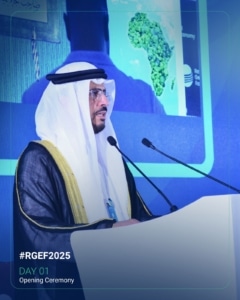 WGEO President H.E. Saeed Mohammed Al Tayer noted that African cities are on the front line when it comes to rising temperatures, water scarcity and environmental degradation. ‘Cities are not only vulnerable; they are vital engines of positive transformation.’ He noted that through the Global Alliance for Green Economy (GAGE), which brings together more than 90 countries, WGEO has created a dynamic platform for inclusive, green and resilient growth. With Africa as the cornerstone of this alliance, in collaboration with UCLG Africa, the WGEO’s ‘Carbon Neutral Cities’ initiative aims to empower African cities to lead the transition to low-carbon, climate-resilient urban environments. ‘This forum is more than an important milestone, it is a springboard for action,’ he added.
The forum welcomed high-level participants, including ministers, mayors, youth leaders, entrepreneurs and experts from across Africa and around the world, to explore practical and sustainable ways to achieve carbon neutrality in African cities.
Following two days of discussions, which included around 30 sessions, round tables and workshops, the forum resulted in the adoption of the ‘Tangier Declaration’. The document calls for accelerating the transition of African cities towards a green economy and carbon neutrality.
 Participants highlighted 15 commitments to achieve this goal. These commitments include accelerating the transition to carbon-neutral African cities by integrating this goal into urban development plans and local climate strategies, in line with updated Nationally Determined Contributions (NDCs), based on a shared vision of an inclusive green economy.
The declaration also recommends promoting innovative and inclusive partnerships between the public and private sectors, and encouraging private sector participation to mobilise investment in key sectors, including renewable energy, energy efficiency, sustainable solid waste management, climate-smart agriculture, water reuse, clean transport, digital solutions for urban sustainability, and green buildings.
Participants emphasised the importance of integrating nature-based solutions, such as urban reforestation and coastal zone protection, as essential pillars of carbon-neutral city planning frameworks (Read the full statement here).
The closing ceremony featured the reading of a letter of allegiance addressed to His Majesty King Mohammed VI.