
4th Conference on “Human Rights Go Local: What works? Accountability in Action – Human Rights Action Plans of Local Governments”
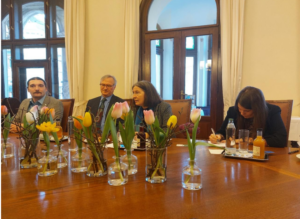 On Thursday, February 8, 2024, at the invitation of the International Centre for the Promotion of Human Rights at Local and Regional Level, under the auspices of UNESCO, UCLG Africa’s strategic partner since 2017, UCLG Africa’s Director of Development, Knowledge Management and the African Local Governments Academy (ALGA), Dr. Najat Zarrouk, participated in the 4th Conference on 4th Conference on “Human Rights Go Local: What works? Accountability in Action – Human Rights Action Plans of Local Governments”.
The Conference was held at the headquarters of ORF Landesstudio Steiermark (Styrian Regional Television Studio), and was attended by mayors of Austrian cities, representatives of political parties, and representatives of local human rights and migrant rights organizations, among others.
Welcome addresses were given by Hon. Mrs. Renate Kicker, Director of the European Training and Research Centre for Human Rights and Democracy (ETC); Mr. Klaus Starl, Director of the UNESCO International Centre for the Promotion of Human Rights at Local and Regional Level, based in Graz, Austria; Hon. Mr. Gerhard Koch, Director of the Austrian Broadcasting Corporation ORF, Styria Office; Hon. Mr. Peter Riedler, Rector of the University of Graz, Austria.
The official opening ceremony featured speeches by : Hon. Mrs. Elke Kahr, Mayor of Graz, Austria; Mrs. Barbara Eibinger-Miedl, Councillor of the Provincial Government of Styria, Austria; Mr. Christoph Thun-Hohenstein, Ambassador and Head of the International Cultural Affairs Section of the Federal Ministry for European and International Affairs, Austria.
The Conference was marked by speeches on “Lessons for local authorities from 75 years of human rights treaties”, delivered by Mrs. Gabriela Ramos, Assistant Director-General for the Social and Human Sciences Sector at UNESCO, and Mr. Marc Cools, President of the Congress of Local and Regional Authorities of the Council of Europe.
Session on human rights action plans and local government accountability:
What are the features that make human rights action plans an essential instrument for fostering local government accountability? Why is it important to build the capacity of civil servants, future leaders and civil society in the field of human rights action plans? Why is it essential to create networks and share experiences and best practices at all levels worldwide?
In a high-level discussion, representatives of cities, city networks, city coalitions and international organizations gave their views, sharing concrete, practical ideas and visions for the future. City representatives demonstrated responsibility in action, in the spirit of the conference title. This network should inspire other cities to follow suit.
The Panel was composed as follows: Mrs. Elke Kahr, Mayor of Graz, Austria; Mr. Robert Lewis-Lettington, Senior Advisor on Land, Housing and Human Rights, UN-Habitat, Geneva; Mr. Pradeep Wagle, Chief of the Economic, Social and Cultural Rights Section, OHCHR; Mrs. Najat Zarrouk, Director of the African Local Governments Academy of UCLG Africa, Morocco; Mrs. Evein Obulor, Director of the European Coalition of Cities against Racism (ECCAR); Mr. Alexander Lesigang, Austrian Association of Cities, Vienna Office, European and International Affairs Division (Agenda 2023 – UN MDGs); Mr. Elliott King, Cabinet Member for Equality, Human Rights and Culture, Swansea Council, Wales, United Kingdom; Mrs. Adele Dunstan, Strategic Coordinator for Equality and Human Rights, Swansea, Wales, United Kingdom; Mrs. Aly Raposo, Coordinator of the Human Rights Committee of Winnipeg City Council, Canada.
The representative of UCLG Africa recalled the quote by Alexis de Tocqueville (On Democracy in America, 1835): “The strength of free peoples, however, lies in the city. Municipal institutions are to liberty what elementary school are to knowledge; they bring it within the reach of the people; they give them a taste for its peaceful practice and accustom them to its use. Without municipal institutions, a nation may claim to have a free government, but it does not possess the spirit of liberty”.
Local government is the appropriate and essential level of governance where human rights can be implemented, respected and protected. Another solid and obvious reason: the only institution that has an impact on a citizen from birth to death is the city, and this throughout his or her life, through basic public services: water, electricity, sanitation, education, housing, health, public transport, public spaces…
For UCLG Africa, and as affirmed by the international community, the SDGs are local in nature. Localizing the SDGs and other global agendas for sustainable development is therefore one of the priorities of the pan-African organization through several pillars of action and activities, as well as solid methodology and tools, explained Dr. Najat Zarrouk.
The UCLG World Secretariat is in the habit of circulating a questionnaire each year among its regional sections, including the Africa section, for the collection of data on how national and regional associations of local governments, as well as cities, are dealing with the localization of the SDGs, focusing on those retained by ECOSOC and the High Level Political Forum (HLPF) for the year.
The HLPF is the opportunity to advocate for local governments and serves as a space to defend their Voluntary Local Review (VLR) in close coordination with their national government, and to share best practices and raise challenges. The members of UCLG are provided with guidelines, tools and training programs in the preparation of their Voluntary Local Review (VLR) or Voluntary Sub-national Review (VSR).
Within UCLG Africa, empowerment, capacity building and development of members and networks is also one of the pillars of action, “because we believe that we cannot succeed if decentralization, local governance and local development are not based, led, implemented, managed and leveraged by committed, ethical, professional, dedicated and high-performing human capital, be it political leaders, elected men and women, human resources or communities.” ALGA director continued, affirming that the creation of the Academy is a good practice that UCLG Africa is honored to share with its members and partners around the world, as it is based on a solid, diversified and mixed methodology, and on a strong network of partners.
As far as networking is concerned, UCLG Africa has a strong tradition of building and supporting networks that the organization considers to be an asset (UCLG and its 7 regional sections, REFELA for locally elected women, YELO for young local leaders, FORAF for African regions, professional networks for territorial managers…). This work stems from the need for strong political will, a clear vision, appropriate resources (human, technical, technological, logistical…), a solid roadmap, a holistic methodology for implementation, and an enabling environment.
Visit to Graz City Hall
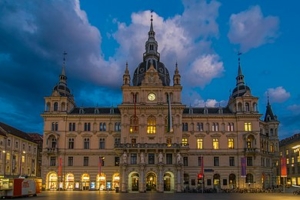 The delegation representing the various partners and stakeholders invited to the conference, led by Professor Klaus Starl, Director of the International Centre for the Promotion of Human Rights at Local and Regional Level, under the auspices of UNESCO, was welcomed by the Honorable Mayor of the City of Graz, Mrs. Elke Kahr and her team. Elected in 2021, she presented her vision and main commitments:
– To make the respect and integration of human rights a fundamental value within the Council, the staff and the population, treating all the city’s inhabitants on an equal footing;
– “We are all Graz” is the slogan of the city;
– Ensuring equal access to public services;
– Working on the principle of integration, bearing in mind that the city is home to a variety of nationalities from different parts of the world, including refugees, migrants and displaced persons. For the city, the great challenge is to offer them a better living environment, in the firm belief that all people living in Graz form a single community, whatever their nationality, race, religion or social status…
Among the city’s structures is the Human Rights Council, which brings together all relevant actors and stakeholders, based on the priority that human rights be integrated into the city council’s vision, policies, decisions and services (access to healthcare, ending gender-based violence, inclusion, accessibility, mobility…).
The Honorable Mayor of Graz has made access to housing one of the objectives of her mandate, in terms of accessibility and affordability, through a solid action plan based on the following key elements:
• City investment in housing, alongside state, regional or private sector supply
• Regulation of the private market, and here the role of government is central in terms of adopting appropriate laws and regulations
• Respect and disseminate quality standards (the waiting list must not exceed one (1) month, every house must have a bathroom, etc.)
• Avoid, through housing, creating “ghettos” or areas of segregation based on social conditions
• Since 2016, the city has been building its own public and non-social housing
• The cost of access to housing must not affect citizens’ salaries
Although the city faces serious challenges (existence of various players, increase in demand compared to supply, financial resources, accessibility of land, etc.), the Mayor of Graz is counting on the creation of partnerships and coalitions at several levels, obtaining good contracts to keep loan interest levels low, investing in inclusive and participatory approaches…
The city’s greatest concern is to offer alternative solutions to the private sector.